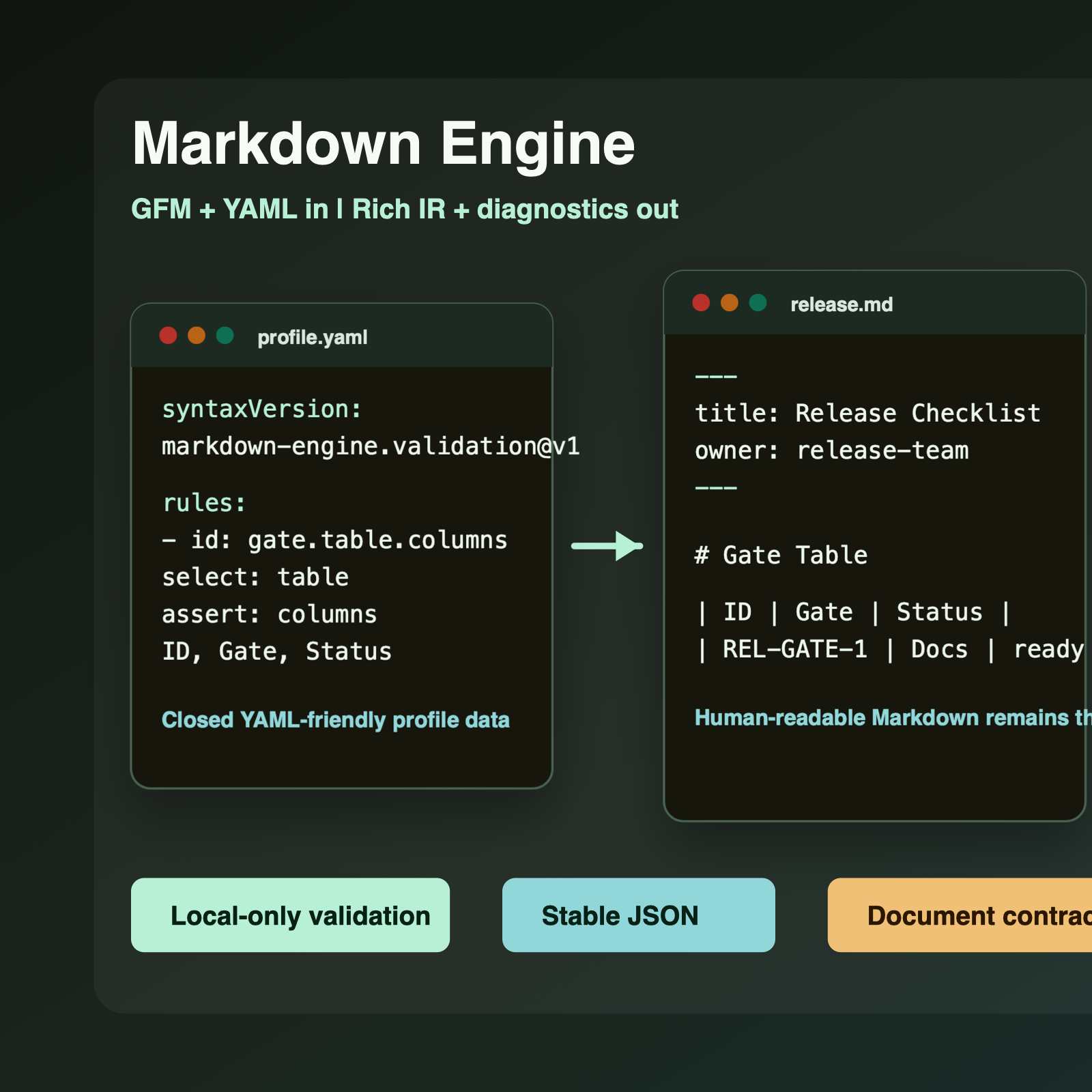
The Markdown looks fine.
A checklist reads well, but a release gate, owner field, or evidence link can silently drift out of shape.
Package 3.0 | Conditional V2 validation | OKF v0.1 examples | Rich IR 1.0.0
A deterministic parsing and conditional validation boundary for teams that need Markdown to behave like an operational contract, not an unchecked blob of prose.
Plain-language story
Teams often keep serious work in Markdown: release checklists, operating specs, handoff notes, requirements, and agent instructions. Those files are easy for humans to read, but most tools still treat them like loose text.
That means a document can look finished while a required section is missing, a table column was renamed, a release gate has no owner, or an evidence link no longer proves anything. The mistake is usually found later, during review, release, or handoff.
Markdown Engine lets a team write simple rules for the document: these sections must exist, these fields at the top must be present, these IDs must be unique, and these links must point to the right evidence. Conditional V2 profiles can also say when a rule applies, which document shapes are acceptable, how many IDs are required, and where traceability IDs must appear. Then it checks the file locally and returns clear pass/fail or skipped results that a person, CI job, or agent can trust.
A checklist reads well, but a release gate, owner field, or evidence link can silently drift out of shape.
A small rules file says which headings, fields, tables, IDs, text, links, alternatives, and conditional checks the document must satisfy.
The engine gives the same answer every time and points to what is wrong before the file is reviewed, merged, published, or handed to an agent.
Consumer value
Markdown Engine gives downstream tools a stable document model, deterministic validation, and diagnostics that can be reviewed, stored, diffed, and gated in CI.
Normalize GFM, frontmatter, source ranges, links, lists, tables, sections, and text spans into an engine-owned IR instead of binding consumers to raw parser ASTs.
Express required headings, frontmatter fields, table columns, IDs, literal text, links, trace references, alternatives, and rule-level applicability with closed YAML-friendly profile data.
Run the CLI or API before a release, handoff, or agent task and get structured diagnostics, grouped rule details, and evaluated or skipped rule counts instead of late reviewer discovery.
V1 profiles keep their existing behavior. V2 profiles opt into conditional validation while regex-like keys, executable-like keys, accessors, proxies, cycles, and unsafe shapes stay inert.
Conditional V2 release
`markdown-engine.validation@v2` adds conditional validation without changing the rich IR document contract. A profile can validate alternative shapes, skip non-applicable rules explicitly, enforce ID cardinality, and prove table-column traceability while v1 profiles remain on the established flat result shape.
Rule-level applicability keeps one profile useful across variants without duplicating profile files or fabricating failures for absent sections.
Branch results stay nested and deterministic, so successful alternatives do not leak failed-branch diagnostics into the top-level outcome.
`ids.minCount` and `ids.maxCount` let release, requirement, and evidence tables prove expected cardinality instead of only uniqueness.
`tableColumnCoverage` verifies configured source IDs in a configured target table column, not just somewhere in nearby prose.
Non-matching `when` rules return `status: "skipped"`, `evaluation.kind: "skipped"`, and `skippedRuleCount` instead of disappearing from the result.
`profile.syntaxVersion` is the discriminator. Existing v1 profiles keep their flat rule results, evidence shape, and validation semantics.
New OKF v0.1 example seal
OKF stands for Open Knowledge Format. Google Cloud introduced it in June 2026 as an open, vendor-neutral way to package curated knowledge as Markdown files with YAML frontmatter so both people and AI agents can read the same source.
An OKF bundle is just files: concept documents, optional `index.md` files for navigation, and `log.md` history. YAML frontmatter carries queryable metadata, while the body stays readable Markdown.
OKF gives teams a common shape for business meaning, schemas, runbooks, metrics, and process knowledge so producers and consumers can exchange context without a proprietary service or custom SDK.
It does not discover or route OKF files. It validates the Markdown/profile pairs a caller supplies: required frontmatter, reserved-file exceptions, log date headings, and per-document evidence through `validateDocumentSet`.
A coding agent can draft OKF Markdown, run Markdown Engine locally, read structured diagnostics, repair the bundle, and repeat until the output is certifiably valid against the chosen OKF profiles.
OKF gives the shared interchange shape. Product teams can add stricter profiles for required fields, allowed concept types, naming conventions, evidence links, ownership metadata, or release-specific quality bars.
Where it fits
The package is intentionally narrow: parse, normalize, validate, serialize. That makes it useful as the deterministic substrate for docs platforms, release operations, requirements evidence, and future agent runtime lenses.
Keep required document sections, frontmatter, links, tables, and structural IDs consistent across repositories.
Turn release checklists into repeatable local gates before npm packing, publishing, or human approval.
Feed coding agents normalized document contracts and deterministic evidence instead of asking them to infer process from raw Markdown.
Grounded workflows
The Conditional V2 example maps to the release fixture suite. The v1 examples map to shipped reader fixtures, and the `SKILL.md` and `PLAYBOOK.md` patterns show how consumers can define their own document types with the same deterministic contract model.
Conditional V2
A release team wants one profile to handle optional verification sections, grouped structural alternatives, exact requirement counts, and traceability coverage. Conditional V2 makes the skipped path explicit and still proves every REQ ID appears in the Traceability table's Requirement column.
syntaxVersion: markdown-engine.validation@v2
documentVersion: "1.0.0"
rules:
  - id: repeatability.flat.text
    select:
      target: section
      title: Mission
    assert:
      text:
        contains: launch

  - id: repeatability.grouped.anyof
    anyOf:
      - label: verification-section
        select:
          target: section
          title: Verification
        assert:
          exists: true
      - label: mission-ready
        select:
          target: section
          title: Mission
        assert:
          text:
            contains: Ready

  - id: repeatability.when.skipped
    when:
      select:
        target: section
        title: Verification
      assert:
        exists: true
    select:
      target: document
    assert:
      text:
        contains: DO NOT EVALUATE

  - id: repeatability.ids.count
    select:
      target: tableCell
      column: ID
    assert:
      ids:
        prefix: REQ
        minCount: 2
        maxCount: 2

  - id: repeatability.table.coverage
    select:
      target: document
    assert:
      tableColumnCoverage:
        source:
          section: Requirements
          column: ID
          prefix: REQ
        target:
          section: Traceability
          column: Requirement
require: everySourceId# Mission
Ready for launch.
| Owner | Status |
| --- | --- |
| Flight | Ready |
# Requirements
| ID | Statement |
| --- | --- |
| REQ-1 | Build safely |
| SYS-1 | Ignore non-requirement IDs |
| REQ-2 | Launch safely |
# Traceability
| Requirement | Evidence |
| --- | --- |
| REQ-1 | Unit test |
| REQ-2 | Integration test |Quickstart
Start with the CLI to inspect behavior against bundled fixtures, then move the same deterministic path into your application code. Existing v1 profiles continue to run unchanged; Conditional V2 begins when a profile declares `syntaxVersion: markdown-engine.validation@v2`.
Add the engine to the project that owns your Markdown workflow.
npm install @jasonbelmonti/markdown-engineValidate a real release checklist fixture and inspect JSON output before authoring your own v2 profile.
npm exec -- markdown-engine validate \
  --file node_modules/@jasonbelmonti/markdown-engine/fixtures/declarative-validation/examples/release-checklist/pass.md \
--profile node_modules/@jasonbelmonti/markdown-engine/fixtures/declarative-validation/examples/release-checklist/profile.yamlParse, normalize to rich IR, compile the syntax-versioned profile, and validate locally.
import {
  normalize,
  parse,
  parseValidationProfile,
  validateWithProfile,
} from "@jasonbelmonti/markdown-engine";

const parsed = parse(markdown, { path: "release.md" });
const normalized = normalize(parsed.parsed);
const profileResult = parseValidationProfile(profileYaml);

if (!profileResult.profile) {
  throw new Error(profileResult.diagnostics[0]?.message ?? "Invalid profile");
}

const result = validateWithProfile(
  normalized.document,
  profileResult.profile,
  { includeEvidence: true },
);

console.log(result.valid, result.diagnostics);
Stable contracts
Package 3.0 adds explicit Conditional V2 validation while keeping the serialized rich IR at `documentVersion: "1.0.0"` as the default output for `normalize(parsed)`. V1 profiles keep their existing result and evidence shape; v2 results expose rule `status`, `evaluation`, evaluated counts, and skipped counts. Legacy consumers can still request the retained `0.0.0` document shape explicitly.